 |
Home | Contents | Orders | Customer Comments | News and Information |
News and
Information
Some interesting facts related to our business appear on this page. The content will evolve with time.
About Lab Grown Gemstones
In the
jewelry trade, "lab-grown", "synthetic", "man-made", and "created" all mean the
same thing -- gemstones that have the same chemical composition, crystal
structure, density, hardness, refractive index, dispersion, and other physical
properties as their natural counterparts, but are grown in a lab instead. We use
the terms interchangeably on our website. In contrast, "simulated" is a term that
describes gemstones that look like their natural counterparts but have different
chemical composition and physical properties. For example, blue spinel
simulates blue sapphire, as does blue CZ. Color change lab sapphire
simulates Alexandrite, green glass simulates emerald, clear cubic zirconia (CZ)
simulates diamond, etc.
Usually companies are accurate in their use of these terms, but sometimes unwarranted statements are found in advertising. For example, one website states: "LAB sapphires are not SYNTHETIC sapphires, don't confuse the two. LAB's are sapphires grown in labs. Synthetics are made of something else that MIMICS sapphires." This an inaccurate and misleading statement, where the source should have used
SIMULATED instead of SYNTHETIC. One lab-grown gem material that is most often misrepresented is Alexandrite. Very often, sellers of lab grown color-change corundum (sapphire) will call their material synthetic or lab-grown alexandrite when it should be called simulated alexandrite. Be careful that the lab alexandrite you buy has the chemical formula for alexandrite -- BeAl2O4.What is the Portuguese Brilliant Flower Cut?
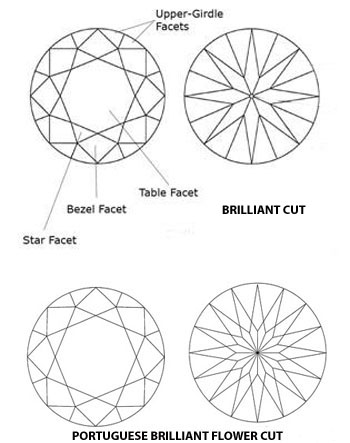
Many of our gemstones are faceted in a Portuguese Brilliant Flower Cut. How does this differ from a standard brilliant cut? The crown, or top of the gem, is the same in both cases. The difference is in the lower part or pavilion. In the Portuguese Brilliant Flower Cut, the pavilion has twice as many facets and this gives the gemstone more "sparkle" or apparent brilliance as it is turned in the light. The picture illustrates the difference in pavilions for the two cuts in the case of a round gemstone. The general principal is the same for ovals, hearts and trillions -- twice the number of pavilion facets.
Cut gem size comparison
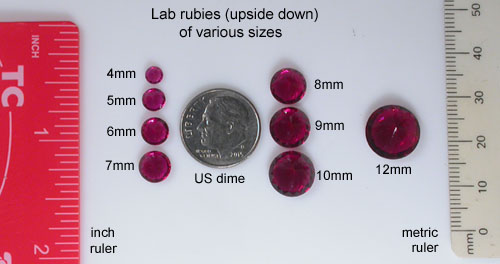
It might not be clear what size
stone to choose, especially if you're more familiar with inches than with
millimeters. Here is a photo showing the different sizes of the round Portuguese
brilliant flower cut next to each other.
(Since these lab-grown rubies are upside down in order to lay flat for the
photo, they aren't showing the beautiful sparkle they have when right-side up.)
Note that, depending on your screen, these may not be displayed as actual size.
Please refer to the rulers and the dime to visualize what size these gemstones
are.
Carats, Karats, Carrots?
Sometimes there is confusion about the terms "carat" and "karat" as
they are used in describing jewelry. A carat (ct) is a unit of weight used for
gemstones. It probably originates from the carob seed which, because of its remarkable
uniformity in size and weight, was used in early times as a comparison weight for
gemstones. It takes approximately 5 carob seeds to weigh 1 gram. Now, the
carat is defined as exactly 1/5 of a gram. For very small stones, the carat is
further subdivided into 100 points (e.g. a 1/4 carat stone weighs 25 points).
1 carat = 100 points = 0.2 grams = 200 milligrams = 0.007 ounces.
A karat (kt, or k) is a completely different animal used to describe the fraction of pure
gold in a gold alloy. Pure gold is said to be 24 kt gold. A number smaller than 24
means the gold is alloyed with other metals (usually copper and silver) . If the alloy is
1/2 gold or 50% gold, it would be called 12 kt gold (12/24 gold). A typical 18 kt
gold item might contain 18 parts gold, 3 parts copper, and 3 parts silver for a total of
24 parts. This is the same as saying it is 75% gold, 12.5% copper, and 12.5% silver.
We probably inherit this cumbersome system from the old practice of subdividing
ownership of a merchant vessel into 24 shares. One reason for confusion is that
sometimes the spellings carat and karat are used interchangeably. However it is
spelled, if applied to gemstones it is the weight; if applied to gold it is the fraction
(in 1/24's) of pure gold in the alloy.
New synthetic vanadate garnet
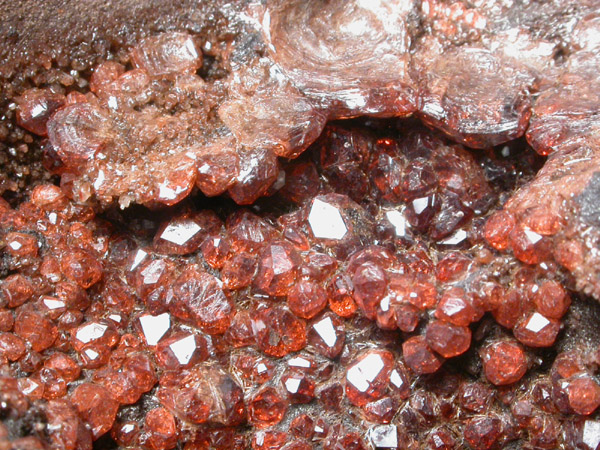
We've been experimenting with the crystal growth of a new garnet-structured material, a calcium sodium magnesium vanadate garnet Ca2NaMg2V3O12, and published a paper on it in the Journal of Crystal Growth (T.F. Ciszek, “Growth of Alkaline-Earth Vanadate Garnet by Synthetic Contact Metamorphism with Molten V2O5-Na2SiO3 Acting on Dolomite,” J. Crystal Growth 287 (2006) pp. 323-325). It is a pretty orangey-red color, as shown here in the photo of a drusy crystal cluster. If you would like to see more details about this material, a preprint of the paper can be viewed at vanadate garnet preprint.
Padparadscha Sapphires
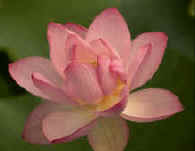
The rarest and most valuable fancy color sapphires (colors other than the stereotypical blue) are exquisite orangy-pink or pinkish-orange gems named "padparadscha" after the lotus blossom. The exact color has always been a matter of debate: different dealers and different laboratories around the world disagree on the exact color described by this term. Perhaps this is partially because the lotus blossom itself can have a range of color shades. Natural padparadscha sapphires (sometimes called pads) sell at a premium, nearing the price for a fine blue sapphire. Prices of several thousand dollars per carat are not unusual. Although the exact color description is debated, the beauty of these rare gemstones with their delicate blended pink and orange shades is universally esteemed. Found originally in Sri Lanka, pads have become collectors' items which are bought up as quickly as they are found.
 |
 |
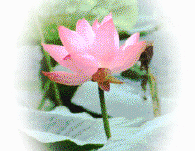 |
| Lotus blossom photo by Yasuko Seki | Pinker version of the lotus blossom |
|
Examples of our padparadscha gems |
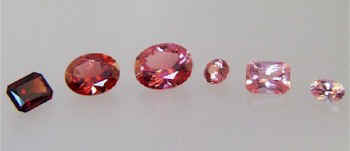
Geolite's laboratory-grown, padparadscha-colored fancy sapphires are produced by slowly cooling high temperature solutions containing the aluminum oxide that is common to all rubies and sapphires along with coloring (doping) compounds such as titanium oxide (it is chromium oxide that colors both ruby and conventional pink sapphires, depending on the concentration level). The single crystals of our padparadscha sapphires grow motionless, submerged in the liquid, without the rotation and harsh thermal perturbations present in melt-grown crystals by the Czochralski pulling or Verneuil flame-fusion techniques. Rotation and thermal perturbations cause banding and other defects that detract from the clarity of the material. Gems cut from Geolite man-made sapphire crystals are exceptionally bright, and we are able to bring them to you at a price that is a small fraction of the cost of natural padparadschas. They have the same hardness, composition (aluminum oxide), density, etc. as natural sapphire, but are grown in the laboratory instead of in the earth's mantle.
Quantity Orders
| Do you need a large quantity of a particular gem or piece of jewelry? In many cases, we can help you with quantity orders, but we need a long lead time since the crystal growth processes and the gemstone cutting both take considerable time. Plan ahead at least 5-6 months for such needs. |
|
Information Resource on Gem and Jewelry Related Topics
The Ganoksin Project,
http://www.ganoksin.com/index.htmOpen to the public, free of charge - a substantial library of articles, publications, reports, and technical data on gem and jewelry related topics; as well as a sizable collection of art and jewelry galleries, for both the casual visitor and the professional.